Format: 2 Day Course
Day 1: A crash course of Cecil’s Immediate Action Jiu Jitsu material in the morning and a crash course of Cecil’s Immediate Action Pugilism in the afternoon.
Day 2: Moving on site to real world locations to practice and apply skills from day 1 and experiment with how these skills work on things like buses/couches etc. Taking the material from the mat to the real world.
Personal Background/Experience level:
I had taken Cecils IAJJ course in London 8-9 years ago – the whole day course. Since that time I have also trained with a lot of the other ‘Shivworks collective’ instructors – Jerry Wetzel, Paul Sharp, April William. This is worth noting because the similarities in what this group has developed are substantial but each instructor teaches in their own way and adds their own take on the core material. At the time of taking this course I had also been training for 6 months 3-4 times a week at a BJJ gym.
Other background for the reader: Most attendees of this class have attended multiple classes together and done private training together. This means there was a strong level of trust and knowledge of when to push each other but also when to back off with newer members with physical or experience discrepancy.
Day 1 AAR.
Cecil’s introduction was at pains to point out a few key things. This weekend was not about running a ‘fight club’. Classes like ECQC can tend towards that full throttle fight club experience – that is like a real testing environment. This class however was about creating space to learn the critical skills and gently ratcheting up pressure against each other.
It is not about ‘winning’ every encounter or going as hard as you can against your training partner.
I found this very helpful as it sets the stage for the day and attitude. Yes with some of the guys alike in size/skill you are going to be pushing them but it isn’t about going 100% with everyone all the time. It’s important to create time and space for people to get something from the deluge of information to come.
The other element of Cecil’s instruction that is more unique is his emphasis on working from the worst case scenario. We are not turned on 100% of the time so let’s focus on starting from the bad position of being ambushed and caught off guard. From fighting off the ground.
Cecil has thought very carefully about how fights work and has established a triage model to run through:
Survive
Defend
Escape
Reverse
Stabilize
Progress
Finish
This guiding principle was something we would come back to and informed how Cecil instructed the defense from the ground.
The starting point of IAJJ is how to survive a ground fight – we start on the ground and roughly speaking the format was as follows:
Bad guy is standing and closing in – different options to take him to the ground (ankle sweep, tripod sweep, de la riva sweep). Just getting up is rarely a good option if your opponent is standing/closing distance.
How to orientate and defend from being on the ground. We worked mainly from a version of side control. The principle here is orientating to face your opponent. Working from being pushed over whilst eyes closed helps drill this behavior.
All standard jiu jitsu ‘rules’ are gone over here. Elbows tight to ribs, orientating to opponent, creating space from the ground.
This leads into discussion of driving escapes through Hip Lifts and Hip Escapes (shrimping). On a pure BJJ level Cecil’s emphasis on developing a strong powerful hip lift and shrimp were really important. A lot of BJJ guys don’t emphasize this movement (in his experience) and this can make a big difference in escapes.
From here it’s all about continuing the escape and driving to knees or establishing a guard. From that we worked a kind of framed technical standup
The outcome of IAJJ (as I understand it) is to give students a framework of how to survive on the ground and get to their feet/establish a basic guard to fight from. I certainly think my few months of BJJ really helped cement this the 2nd time around, knees coming up as a shield more automatically, pinning elbows in, shrimping and hip driving all just felt more natural.
LUNCH
This day was very much a firehose and even though the first half of the day felt familiar and based on a lot of situations one comes across in regular open mat there are differences. The afternoon was moving us into Cecil’s Immediate Action Pugilism – I had never done this as a stand alone class.
IAP
The afternoon session is focused on developing the default cover or helmet protection from incoming strikes and then fighting in the standing clinch.
This is the really difficult stuff in my opinion. The standing clinch is what I find difficult, where I find my skills lacking, and where it becomes ‘scary’ once weapons and multiple opponents come into play.
The standing clinch work more than anything else will convince the attendee of the reality that weapons are not magic wands. Getting to your gun is difficult, getting to a well set up knife is considerably easier but still not a given.
Default Cover/Helmet is something covered in almost every shivwork connected hand to hand class and it’s always good. Cecil was quick to point out my tendency to blade a bit and lead with my elbow – something I need to work on. It’s a position to crash but squaring the hips to drive is critical to not get off track and end up in a weakened stance.
One of Cecil’s strengths in teaching, like all great instructors, is the crawl, walk, run approach. In this manner we increased the complexity of handfighting clinch work. This is standard for great instructors but I think what marks Cecil out is his ability to then bring it full circle to show you how the principles apply.
It isn’t about a perfect technique, it is about applying principles of positioning to gain advantage and survive the clinch. Much of our drill work focused on getting to a control position that can be held for a count of 3 seconds.
The afternoon did blur a bit for me, the pace is high and a lot of the material was familiar but it’s still an overload. I felt Cecil explained a lot more or the clinch fighting principles in a way that makes more sense to me. The stressing of how important it is not to lose once weapons come into play is a lesson that was expanded upon the next day.
We finished up after about 9 hours of instruction.
Day 2
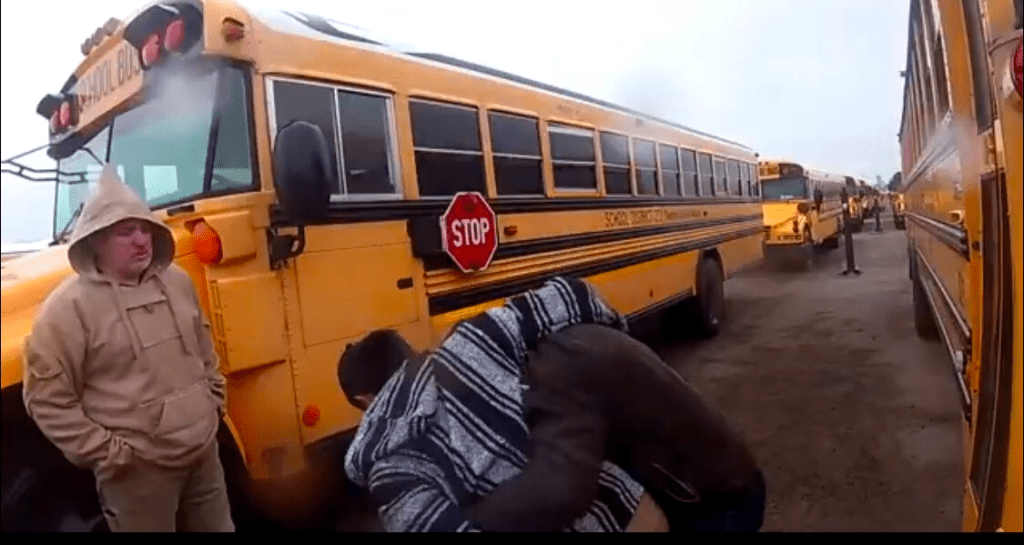
Day 2 we met at a School Bus Transport Depot.
We warmed up with some swimming wrestling drills and going over basics of clinch work. Default cover was also part our warm up – reacquainting ourselves with the optimal way to set up and drive into someone.
The warmup followed the crawl, walk, run format and culminated in some tougher resistance rounds of clinch work – fighting for dominant position and control.
We then moved to a space between two of the school buses, representing a narrower corridor with real gravel underfoot and obstacles present. The objective in this exercise was for bad guy to keep the good guy in the channel, good guy was fighting to escape.
This exercise really highlighted to me just the importance of having a goal to drive towards and taking position – one thing I got rightfully called out on (as did a few others!) by Cecil was to be wary of playing foot take down attempts. BOTH going to the floor would be bad, staying upright and mobile and fighting the standing clinch is preferable. A good lesson.
As the rain picked up a bit and we were going to do more close quarter standing escape work we moved inside the school bus. My first time in an American school bus and it was fighting straight away…!
Here we began to work on how to deal with this kind of fight, and the principles from Day 1 were fully present. Turn and face opponent in seat, use knee as a shield if needed, create a solid frame. Of course my first round was against someone who had done VCAST and so they knew the dirty tricks but that is life in the Shivworks group!

The evolution of drills on the bus looked as follows:
Fighting a person seated
Fighting a person who is standing
Weapons introduced
Multiple opponents and weapons introduced
One thing I began to notice during the weapons drills, that would become a theme, was most times I went to my training knife. It felt way more secure and useable in that clinch versus a gun.
The bus work meshed the need to use default cover to drive forward when an opponent is standing. Getting pinned by a standing opponent is certainly a terrible position to end up in.
A few other dangers were highlighted, notably being aware of stairs but also the 3d nature of the bus enclosed environment – walls/ceilings/seats become things to be pinned against or push off from.
LUNCH
After lunch we moved into more scenario training at a training building usually used by local PD/Firefighters. It came complete with spooky training dummies.
We started off after lunch with that critical skill that never seems to get enough time: In Fight Weapons Access. Effectively this drill followed a similar format of clinch fighting with the addition of working to actually access your weapon of choice. This is the difficult work that needs to be done and again most times I found myself in a position where I felt more confident accessing a knife as the primary tool.
Further scenarios using different parts of the house took up the rest of the time – we got to do more role playing here even if this wasn’t really a MUC centric class. It added some humor and reality to serious topics.
In terms of another exercise vs live evolutions the last one we did was starting face down on floor with a bad guy on back. Again getting to a knife in that position from a kind of modified turtle changes that game very quickly. As Cecil pointed out, a knife and some grappling skills makes you a very dangerous good guy. It is the closest thing to a magic wand, more so than a gun in such confines.
Our last evolution of the day was in the bathrooms – this was quite intense and a good culmination.
Final thoughts
The day was full on and for sure people didn’t ‘win’ everytime but a lot of learning was done. Confined spaces certainly change things up – one of the lessons I took home was just decisiveness of action and the concept of not losing. There is sometimes an element of a game to training and keeping a focus is important even when you can have fun with it.
In other environments it is easier to manage distance but up close and personal if it goes physical, it goes very physical, very quickly. The default cover as not just a punch protection but as a way to drive out of a seat was another important lesson I took away. It was also good to run drills where getting away was as viable as going to a weapon and think about the differences/pros and cons in such situations.
I found the class very useful, applying stuff off the mat has more risks but the rewards seem worth it and moving off walls/toilet stalls , uneven floors solidifies all the work we do.
 Saps and Blackjacks
Leave a comment